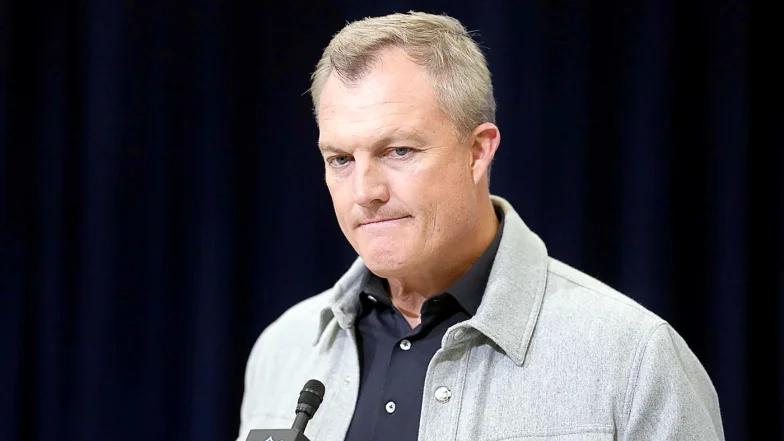
The San Francisco 49ers have approximately $34 million in available salary cap space, and with the November 10 trade deadline approaching, it's easy to look at that number and believe John Lynch can afford another big-name player.
The problem is that San Francisco is already projected to be $31.5 million over next year's salary cap, even after accounting for the NFL's expected increase in the spending limit. That projected deficit doesn't include the unused money the 49ers can carry over from this season.
So while Lynch has $34 million available today, much of it may be needed just to get the 49ers under the salary cap in 2027.
Why the 49ers Need Their $34 Million Next Year
Every NFL team operates under a salary cap, which limits how much player compensation can count against its books in a given season. For 2026, that limit is $301.2 million per team.
Teams can also carry unused cap space into the following season, giving them additional room beyond the league's spending limit.
The 49ers currently have approximately $34 million available, including the salary cap impact of acquiring Buckner from Indianapolis.
For 2027, Over The Cap estimates the NFL salary cap will increase to $327 million. Even with that increase, San Francisco's existing contracts leave the team approximately $31.5 million over the projected limit before applying its rollover.
If the 49ers finish this season with the entire $34 million unused, they could carry that money into 2027 and offset the deficit, leaving approximately $2.5 million available.
Now consider a hypothetical example.
Suppose Lynch acquires another player whose remaining 2026 salary uses $10 million of that available cap space. Instead of carrying $34 million into next year, San Francisco would carry approximately $24 million.
With the same projected $31.5 million deficit, the 49ers would enter 2027 approximately $7.5 million over the cap.
That's only an illustration, not an actual trade being considered. It shows how spending this season can reduce San Francisco's flexibility next year.
How the 49ers Create More Salary Cap Space
San Francisco has regularly used contract restructures to create more salary cap space, and Lynch will almost certainly have opportunities to do so again.
A restructuring typically involves converting part of a player's salary into a signing bonus. The player still receives the money, but NFL rules allow the team to spread that bonus across multiple seasons for salary cap purposes.
For example, if a team converts $10 million in salary into a bonus spread over five years, only $2 million counts against the current season's cap. The other $8 million spreads over the next four seasons.
That creates $8 million in immediate cap room, assuming the salary would otherwise have counted entirely against the current year.
The 49ers have used this approach with expensive veteran contracts, allowing them to maintain a competitive roster while accommodating major financial commitments.
But those future charges remain on the books.
Brock Purdy's contract illustrates the challenge ahead. His projected cap charge is about $23.7 million in 2026 and $30.1 million in 2027, then jumps to $56.9 million in 2028 and $71.8 million in 2029.
Nick Bosa, Trent Williams, George Kittle and Fred Warner also carry significant future commitments. Restructuring their contracts could create more room in 2027, although it would increase the cap charges San Francisco must manage in subsequent years.
The Cost of Acquiring Another Player
When the 49ers traded for Buckner, Indianapolis agreed to cover half of his remaining 2026 salary. San Francisco became responsible for its portion, which is already included in the team's current $34 million cap-space figure.
NFL contracts are accounted for differently when a player changes teams during the season. The acquiring club generally takes on the remaining unpaid salary and applicable future obligations, while the former team keeps the signing bonuses it already paid on its salary cap.
That means a player with a $20 million annual salary wouldn't necessarily cost San Francisco $20 million against its 2026 cap if acquired halfway through the season.
However, a player who remains under contract for 2027 could bring a much larger financial commitment next year. A player whose contract expires after this season presents another decision, since keeping him would require a new agreement.
Buckner is one player Lynch will evaluate after the season, especially if San Francisco wants him to stay beyond 2026.
Six Draft Picks Can Disappear Quickly
The 49ers also have to consider what another trade would cost in draft selections.
After sending their 2027 fourth-round pick to Indianapolis for Buckner, San Francisco will have six selections remaining next year: one each in the first, second, third, fifth, sixth (Baltimore), and seventh (Kansas City) rounds.
Those picks give Lynch opportunities to add younger players whose salaries are controlled by the NFL's rookie contract system.
A player selected in the draft generally signs a four-year contract, with first-round picks also carrying a fifth-year option. That gives teams a chance to develop contributors at costs often considerably lower than established veterans.
With Purdy, Bosa, Warner and other core players commanding substantial portions of the salary cap, affordable young talent becomes increasingly important.
Lynch could trade another third-round pick for immediate help, but doing so would eliminate the chance to add a player who could contribute for several seasons on a relatively inexpensive contract.
Next Year's Deficit Doesn't Include Everyone the 49ers Will Need
The projected $31.5 million deficit reflects the players San Francisco currently has under contract against Over The Cap's estimated $327 million league salary cap for 2027.
It doesn't account for future free-agent signings, the incoming draft class, undrafted rookies, or practice squad players the team will need. Those additions will eat up cap space, while contract restructures and other roster decisions could create more room.
Dre Greenlaw, Deebo Samuel and Buckner are among the veterans whose contracts expire after this season. Mike Evans remains under a multiyear agreement, but with no guaranteed salary after 2026, San Francisco also has to decide his future.
If the 49ers want to retain those players, some may require new contracts at higher salaries. If they leave, Lynch must find replacements, whether through free agency, the draft, or players already on the roster.
The $2.5 million cushion produced by the rollover calculation is therefore only a starting point. It isn't the team's final 2027 spending budget, and it doesn't mean San Francisco is limited to signing $2.5 million worth of players.
Lynch can create more cap room, as he has done repeatedly in previous offseasons, but he'll have to account for the financial consequences of those decisions.
Lynch Still Has Options Before the Trade Deadline
Acquiring Buckner addressed an important need on the defensive line without sacrificing one of San Francisco's first three draft picks. Lynch still has resources available to improve the roster before November 10, particularly if another opportunity develops at a reasonable price.
With the 49ers competing for a Super Bowl, another acquisition could justify the cost, especially if the player can contribute beyond this season.
Lynch has the flexibility to make that decision, but every dollar spent and every draft pick traded will affect the resources San Francisco has available to build its next roster.
More info on: Nick Bosa, Mike Evans, Dre Greenlaw, George Kittle, Brock Purdy, Deebo Samuel, Fred Warner, Trent Williams
Comments